Reading · Grades 5–6 and 7–8
The Instructions Lab
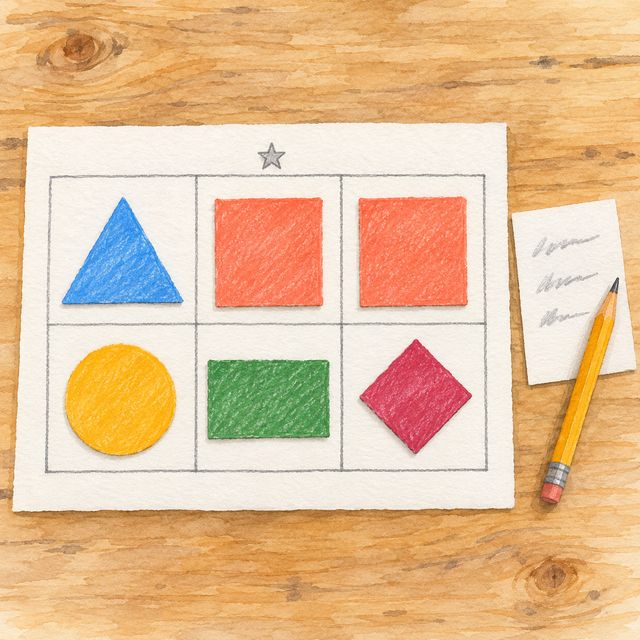
Your child makes a little puzzle that a clearer instruction can repair.
Your child hides a target layout, writes a broad instruction, sees two layouts fit it, then writes one that names every cell and tests it again. At 7–8 they build a three-clue case with one solution.
- Grades 5–6 and 7–8
- 30 min
- A printout
- On the screen
Free to sign up.
Is it a good fit?
- Ready if Your child can measure in centimetres and write a sentence of instructions.
- Too much today? The 5–6 level: one target, one revised card, no clue case.
- Too easy? The 7–8 level: a three-clue case with one solution, and a second set of clues of their own.
What your child practises
- Noticing ambiguity
- Predicting other readings
- Checking a claim against a result
- Revising respectfully
“Both layouts fit those words. Our new sentence tells you which side.”
If your child says something like this, in their own words, the idea has landed. Finishing the rounds means they took part; this is the learning.
Your part
- Follow the words faithfully, without steering the first trial to fail
- Draw the grid or cut larger pieces if that helps
- Act as builder, or let your child use the supplied cards alone
What you need
From home
- Two sheets of scrap paper or card
- A pencil
- A ruler with centimetres
- Scissors you find comfortable
- Crayons or coloured pencils
- An envelope
The steps
Grade 5–6
 Draw the 12 by 8 cm board as the card shows, star at the top. Pick Target A or B, sketch it on the second sheet and fold it.
 Draw the 12 by 8 cm board as the card shows, star at the top. Pick Target A or B, sketch it on the second sheet and fold it.
The other 5 steps, each with its painting, are in the Family portal.
It must pass: Your revised card builds your target with every top cell named, and you can say which word in the first card left room for another layout.
Grade 7–8
- Draw the 12 by 8 cm board as the card shows, star at the top. Pick Target A or B, sketch it on the second sheet and fold it.
The other 5 steps, each with its painting, are in the Family portal.
It must pass: Your revised card names every top cell, and you showed that the three clues have one solution and two without clue three.
Safety
Use scissors your child finds comfortable; a grown-up may cut the pieces, larger if that helps. Collect the scraps and keep the set in the envelope. Stop early if anyone wants to finish. Nothing is recorded or uploaded.
Where the facts come from
Take it off the screen (optional)
Try clearer reference points in a shared school project, a household request or a set of setup instructions.
More like this
The full design
What it is
Can two different arrangements both follow the same instruction, and what wording would make the intended one clearer? Your child makes a board of six cells and six labelled paper shapes, writes "Put the blue piece beside the two red pieces.", sees how two layouts fit those words, and writes a card that leaves one. It is the companion project of the storybook The Rumour That Knew Tomorrow, and does not depend on having read it.
How it goes
One step fills the screen: its painting, its words, and the cards your child copies or checks: the board with its cell names, Target A and Target B, the first card, the sample revised cards, the supplied before and after cards, and the record's four columns. Done this step moves on; Too hard, skip it also moves on and the finish says so. Show and What I learned close it.
The Pet
It asks at each step and notices what a step settles. It answers only the line your child taps, and never claims to have seen the table. A different layout is a reasonable reading, and the Pet says so.
By band
5 to 6: one secret target, the broad card, one trial, a revised card that names every top cell, one retry, then the set packed in an envelope. 7 to 8: the same, then a case of three clues on a cleared board, with one solution, and two once clue three is hidden.
What it grows
The Library of Congress's source-analysis questions (what does it show, who made it) and CASEL's framework for listening, relationships and responsible choices informed how the project is built; the writing standards ask middle-school writers for precise, clear information. Neither source evaluates this project or shows that the skill transfers elsewhere.
Done, and what counts as evidence
Done = the steps done or honestly skipped, and one line chosen at the end. The evidence is on paper: the first and revised cards, the two predicted layouts and the record of what each card settled and left open. One revision and one retry are enough; this is a small demonstration of clearer wording, not a study proving what caused every improvement. Talk about it: which word made the biggest difference? What did we observe, and what did we assume about the other person? Could the card work for someone who never saw the target?
What's personal
Nothing is recorded or uploaded. Alone, your child checks the supplied before and after cards instead of a partner's build; the cards say they are supplied, worked out from the words, not watched. A layout of your child's own is checked against its own words with you, not against the sample.