Science · Grades 5–6 and 7–8
Small push, big lift
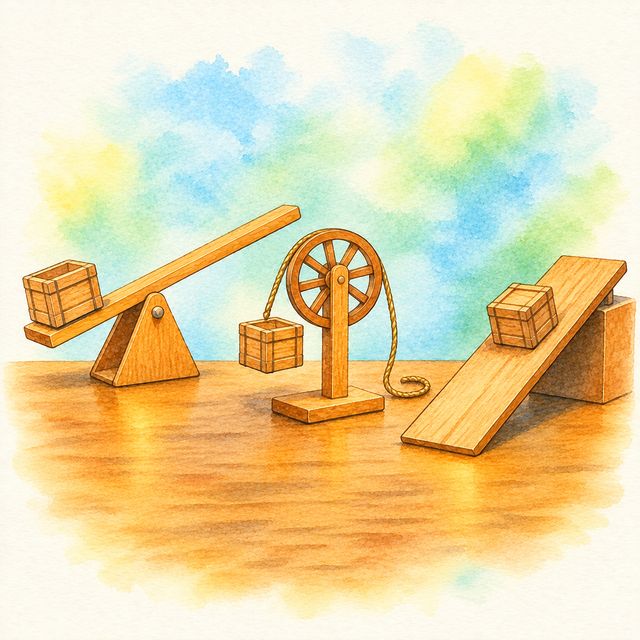
Your child finds the one trade every simple machine makes: less push, for more distance.
Your child checks four things the Pet believes about a drawn lever, pulley and ramp: where to push on a lever, what one pulley really does, whether a ramp is easier than lifting straight up, and what you trade for the easier push. At Grade 7–8 the same three machines are quantified: a lever's arm ratio, a movable pulley's shared ropes, and whether a machine ever truly lowers the total work.
- Grades 5–6 and 7–8
- 15 min
- Nothing to prepare
- On the screen
Free to sign up.
Is it a good fit?
- Ready if Your child has used a seesaw or pushed something up a slope and noticed it felt easier or harder.
- Too much today? Start with Ramp race: a real ramp and a toy car, measured by hand.
- Too easy? The Grade 7–8 level: a lever's own numbers, two pulleys compared, two ramps compared, and the work that never disappears.
What your child practises
- Where to push on a lever
- What a pulley really changes
- Why a ramp is easier
- Force traded for distance (Grade 7–8)
“Less push, more distance. That is the trade.”
If your child says something like this, in their own words, the idea has landed. Finishing the rounds means they took part; this is the learning.
Your part
- Nothing for the game itself
- Each question has a Read it to me button
Take it off the screen (optional)
Build a real lever from a ruler balanced on a pencil, a toy at one end, and feel the push change as you move your finger along it.
More like this
The full design
What it is
A smaller push can lift the same load, every time, by trading force for distance: push less, but further, or longer. A lever, a pulley and a ramp each make this trade a different way; none of them escapes it.
How it goes
The Pet's claim sits over the drawn machine: the lever, the pulley or the ramp, whichever the round needs. Your child checks it from three choices. An answer that does not fit gets the Pet's reason read from the diagram. Four rounds make a game.
The Pet
It believes the plausible wrong turn, never your child's own: position on a lever does not matter, a pulley by itself lightens the load, a ramp costs the same as lifting straight up, a longer push arm needs more push, more pulleys always help however arranged, a short ramp beats a long one, a machine lowers the total work. It asks your child to look at where the push happens and how far it is from the load, and when a round is answered it says what the diagram showed. Its dare is the next step up: at 5–6, a real lever from a ruler over a pencil, lifting a toy; at 7–8, finding a real ramp, lever or pulley at home and naming its own trade.
By band
One drawn lever (a bar on a fulcrum), one drawn pulley (fixed or movable) and one drawn ramp. 5–6: which point on the lever needs less push, near the fulcrum or far; a single fixed pulley changes direction only, never the pull itself; a ramp needs less push than lifting straight up; and naming the trade itself, less push for more distance. 7–8: a lever's push side twice as long needs about half the push; a movable pulley's two rope lengths share the load, about half the pull, twice the rope paid out; a longer, gentler ramp needs less push than a short, steep one at the same height; and the idea underneath all three, that the total work stays about the same, a machine only changes how the push feels.
What it grows
England's national curriculum asks a Year 5 child to recognise that levers, pulleys and gears let a smaller force have a greater effect, after the same year's work on forces, friction and air resistance; key stage 3 extends this to moments and the quantified trade between force and distance, the same "total work stays the same" idea this game's 7–8 rung closes on.
Done, and what counts as evidence
Done means the four rounds answered. "Found the trade" or "said which pulley needs less pull, and why" is an observation you may keep. The best record is off the screen: a real ruler-and-pencil lever, or a real ramp, lever or pulley found at home.
What's personal
Nothing: the lever, the pulley and the ramp are each a drawn model, and the memo says so. No real parts are asked for.