Science · Grades 5–6 and 7–8
Uncle Hamid's Prototype Lab
Your child works out why a made-up machine misbehaves, by choosing tests, and repairs it without breaking what works.
Your child sets four switches on a drawn welcome arch, runs tests, compares two runs side by side, pins the pair only one of three explanations fits, then fits one isolator and checks that the empty arch stays quiet while a visitor still rings it.
- Grades 5–6 and 7–8
- 20 min
- Nothing to prepare
- On the screen
Free to sign up.
Is it a good fit?
- Ready if Your child can read a rule with "or" and "and" in it and say what it predicts.
- Too much today? Start with Secret rule machine: find one hidden rule from cases, before choosing between three.
- Too easy? Settle it in as few new runs as you can, and say why each one was needed.
What your child practises
- Choosing tests that tell explanations apart
- Comparing two runs side by side
- Using evidence to rule an idea out
- Checking that a repair keeps everything working
“If I move the pennant and it goes quiet, it can't be the fan signal.”
If your child says something like this, in their own words, the idea has landed. Finishing the rounds means they took part; this is the learning.
Your part
- Nothing for the game itself
- Each question has a Read it to me button
- Play as the predictor while your child runs the tests, then swap
Take it off the screen (optional)
Next time something at home acts up, a lamp or a remote, list what could explain it, then pick a test the explanations disagree about.
More like this
The full design
What it is
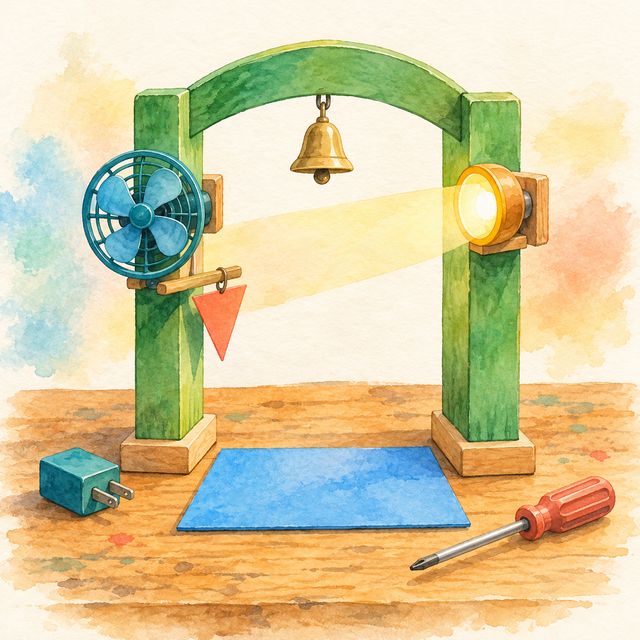
Finding why a machine does something odd, and fixing it without breaking what already works. Uncle Hamid's welcome arch rings its bell when nobody is on the visitor pad. One stray signal, a tiny electrical message, is reaching the bell, and there are three explanations for where it comes from: the fan signal, the light signal, or the beam-sensor signal (the running fan swinging the pennant across the light's beam, which a sensor notices). All three fit the three runs in his notebook, so your child chooses tests that tell them apart, pins two runs only one explanation can explain, then fits one isolator and checks the arch still welcomes real visitors with the fan, the light and the pennant all working. It is a companion game of the storybook The Rumour That Knew Tomorrow, where Uncle Hamid's lamp follows cookies; it plays the same without the book.
How it goes
Find the stray signal: the arch is drawn as your child's Pet projects it. Four switches (the visitor pad, the fan, the light, the pennant on its hook or moved clear) set the next run; a prediction (bell or quiet) is optional and is written on the run's card, never counted as evidence. Run plays the setup, the fan and pennant moving, then the bell (one ding) or a quiet caption, and every run goes in the log, numbered and never changed. Your child taps a reference run and another; the two wait side by side until your child presses Play, headed by what the two saved runs differ in: one setting changed (and which), how many settings changed, or the same setup twice. Your child names the explanation that fits both and pins them. A pin that does not yet hold is answered from the two runs: the run that contradicts the explanation named, or which explanations still fit both. The short way is run 2 from the notebook (fan, light and pennant on: it rang) against the same setup with the pennant moved clear (quiet): only the beam-sensor signal fits both, and that one new run already separates the three. Fan only quiet against light only quiet also settles it, as two diagnostic tests. Help is there when your child asks for it: Compare predictions shows what each explanation predicts for the setup on the bench, Suggest a test gives a direction, and Set up a guided test sets one test up for your child to run. Fix it and keep everything working: one isolator, three sockets (fan, light, sensor); the Pet brings it to the socket your child picks, and the block stays there. It blocks one signal's route to the bell and never switches anything off. Two checks with the fan, light and pennant on: the empty arch quiet, and a visitor ringing it. A wrong socket shows itself (the empty arch still rings), that run is evidence like any other, and the isolator moves. With the fan, light and pennant back in place, the case card: the two pinned runs, the explanation, the socket, the two checks, and the limits of the case (these tests distinguish the three explanations considered; a different one would need tests of its own). The isolator is available from the start, so a child who repairs first and pins second has done the work and repeats nothing. Reset bench puts the switches and the isolator back and keeps the tests; Restart case, after a question, clears the tests, the evidence and the checks.
The Pet
It projects the arch, stands at the part your child sets, walks to the bell for a run, brings the isolator to the socket, and holds two runs side by side. It says what happened and, when your child asks, what each explanation predicts for the setup on the bench. When your child waits, it asks the step's question and points at the help, never at the deciding test. It never sees the hidden fault, never shows a wire the drawing does not show, and never picks the socket. Uncle Hamid's words are on his own card: the challenge, a word when the evidence is pinned, and his close.
By band
One case at both levels, as the design brief asks: a shared version for ages 11 to 14 with optional help the child asks for. 7–8 and 5–6 differ only in the question the finish suggests for a grown-up.
What it grows
NGSS's middle-school engineering design practices ask students to define what a solution must keep working, test models and compare results to improve a design (MS-ETS1-3, MS-ETS1-4); planning an investigation that controls variables is a Grade 6 to 8 science practice. Guided inquiry supports a learner who chooses the tests, with help that points at evidence rather than at the answer.
Done, and what counts as evidence
Done means a pinned pair the game checks as data and a repair checked twice with everything on. This is an observable completion, not proof of mastering fair tests. The best record is a conversation: which results ruled out the other explanations, and what did the arch still have to do?
What's personal
Nothing: the arch, the notebook and the faults are made up for the game, and no family facts are asked for or kept.