Math · Grades 5–6 and 7–8
Pack the Pet's boxes
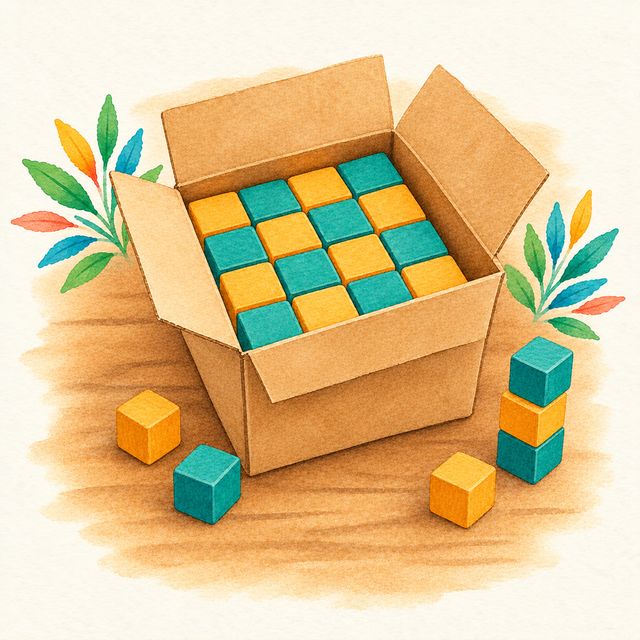
Your child finds how many cubes fill a box, by layers and by length × width × height, and says why.
Your child puts right the Pet's boxes: one layer found and counted, a box from its edges, the box that holds most and a box measured in centimetres, or at Grade 7–8 two boxes joined, a box with every side doubled, the box that needs least card, and a missing side.
- Grades 5–6 and 7–8
- 15 min
- Nothing to prepare
- On the screen
Free to sign up.
Is it a good fit?
- Ready if Your child can multiply two small numbers.
- Too much today? Start with Pizza fractions: parts of one whole, named and drawn, before whole boxes are packed.
- Too easy? The Grade 7–8 level: two boxes joined, every side doubled, the least card, and a missing side.
What your child practises
- Counting cubes in layers
- Length × width × height
- Which box holds most
- Two boxes joined (Grade 7–8)
- A missing side (Grade 7–8)
“How many in one layer, and how many layers?”
If your child says something like this, in their own words, the idea has landed. Finishing the rounds means they took part; this is the learning.
Your part
- Nothing for the game itself
- Each question has a Read it to me button
Take it off the screen (optional)
Measure a real box together and work out how many sugar cubes would fill it.
More like this
The full design
What it is
A box holds layers of cubes: length × width × height. The Pet packs cubes into boxes and gets the volume wrong the way children do ("I counted every cube I can see: 18!"); your child puts it right from the box drawn in cubes.
How it goes
The box sits under the question, drawn in cubes at an angle, or by its edges, or with its measures written beside it. Then three answers, or three boxes to tap, each with its size under it. A box or an answer that is not the one is marked "not this one", and the Pet says why.
The Pet
It believes its own counting, never your child: the cubes you can see are all of them, the sides add, tall is big, two boxes make one, double the sides is double the cubes, thin needs little card, and taking away undoes multiplying. When a round is won it says what the box showed. Its dare is the next step up: at 5–6, two boxes pushed together; at the top, a real box at home, measured, and how many sugar cubes would fill it.
By band
Four rounds a play. 5–6: a 4 × 3 × 2 box (first the slice that is one layer; the Pet counts only the cubes it can see), a 5 × 2 × 3 box with only its edges drawn (the Pet adds the sides), which of three boxes holds most (the Pet picks the tallest), and a 3 × 4 × 5 cm box with no cubes drawn (the Pet adds). 7–8: two boxes pushed together (the Pet makes them one big box), a box with every side doubled (the Pet doubles the volume, where it is 8 times), which box of 24 cubes needs the least card (the Pet picks the long thin one), and how tall a box must be to hold 60 cubic cm on a 5 × 4 base (the Pet takes away).
What it grows
The standards ask a Grade 5 child to see volume as unit cubes packed without gaps, to find it by counting layers and by multiplying length, width and height, and to add the volumes of two boxes joined (Common Core 5.MD.C.3 to 5.MD.C.5); a Grade 6 child to find volume with formulas and surface area from the faces of a box (6.G.A.2, 6.G.A.4); and a Grade 7 child to solve problems with volume and surface area (7.G.B.6). The game asks for the number and the reason, never a term to define.
Done, and what counts as evidence
Done means four boxes packed. "Asked how many in one layer?" is an observation you may keep. The best record is off the screen: a real box your child measures, and how many sugar cubes would fill it.
What's personal
Nothing: every box is drawn for the game, nothing is bought or priced, and no family facts are used. The two boxes pushed together are "the long box" and "the tall box", never a colour. The Arabic lines are written in Arabic, every number as in English.