Math · Grades 5–6 and 7–8
The Pet's treasure grid
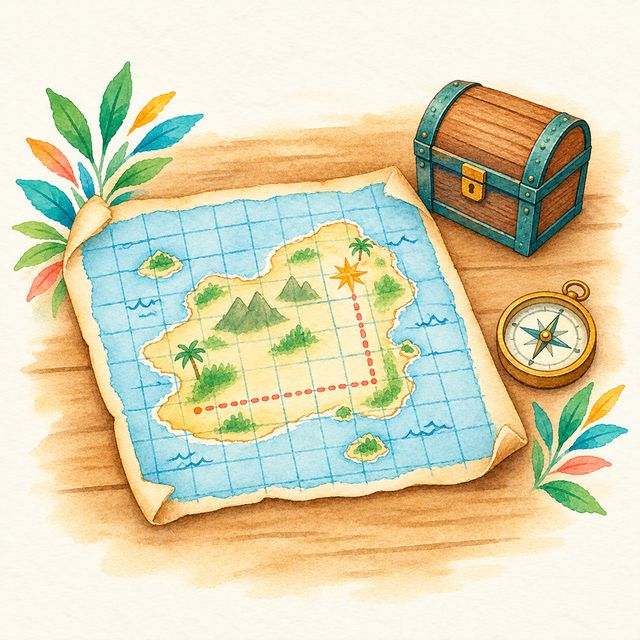
Your child plots and reads points across first, then up, and reads how fast a straight line climbs.
Your child puts right the Pet's muddled map and graphs: plotting and reading points, finding the highest point and the next in a pattern, or at Grade 7–8 reading a rate from a straight line, finding the point off it, and predicting where it goes.
- Grades 5–6 and 7–8
- 15 min
- Nothing to prepare
- On the screen
Free to sign up.
Is it a good fit?
- Ready if Your child counts along a number line and reads two-digit numbers.
- Too much today? Start with Is it fair?: reading bars and dots on a chart, before plotting points on a grid.
- Too easy? The Grade 7–8 level: a rate from a straight line, the point off it, the steeper of two lines, and where a line will be.
What your child practises
- Coordinates
- Reading a grid
- Patterns on a grid
- Rate from a graph (Grade 7–8)
- Predicting from a line (Grade 7–8)
“Across first, then up.”
If your child says something like this, in their own words, the idea has landed. Finishing the rounds means they took part; this is the learning.
Your part
- Nothing for the game itself
- Each question has a Read it to me button
Take it off the screen (optional)
Plant a bean together, measure it each week, and plot the heights on squared paper.
More like this
The full design
What it is
Across first, then up; and a straight line climbs the same every step. The Pet gets its map muddled ("(2, 5)? Easy: up 2, then across 5!"); your child puts it right.
How it goes
The map or graph sits under the question with the Pet's claim beneath it. A crossing, a post, a fare or a choice that is not the answer gets its own reason, and a crossing tapped stays marked. The simpler step lights the line up from the answer's number across.
The Pet
It is the one who mixes the map up, never your child: up before across, the biggest number for the highest, the start for the rate. Its dare is the next step up: at 5–6, a graph of a growing plant; at the top, a bean of your child's own, measured each week for four weeks and plotted.
By band
Four rounds a play, each a tap on the map or a choice of three. 5–6, a map from 0 to 6: tap where (2, 5) is, read where the gem is, find the highest of three lookout posts (the Pet picks the one with the biggest number), and place the next stepping stone (the Pet counts up 1 where each stone goes up 2). 7–8, graphs: how fast a bean plant grows (the Pet reads its starting height as the rate), the taxi fare that is off the line, which of two plants grows faster (the Pet picks the one that started higher), and how tall the plant will be at week 6.
What it grows
The math standards ask a Grade 5 child to graph points in the first quadrant of a coordinate plane and read them in context, and to graph a pattern from a rule (Common Core 5.G.A.1, 5.G.A.2, 5.OA.B.3); a Grade 6 and 7 child to read a unit rate from a graph (6.RP.A.3, 7.RP.A.2); and a Grade 8 child to read the rate of change and the start of a straight line from a graph, and to compare two functions (8.F.B.4, 8.F.A.2). The game asks for the point, the rate and the reason, never a formula.
Done, and what counts as evidence
Done means four maps read. "Across first, then up" is an observation you may keep. The best record is off the screen: a bean your child plants, measures each week and plots.
What's personal
Nothing: every number on the map is the game's own. No money: the taxi's fare is a number with no currency. No family facts are used.