Reading · Grades 5–6 and 7–8
The Pet takes it literally
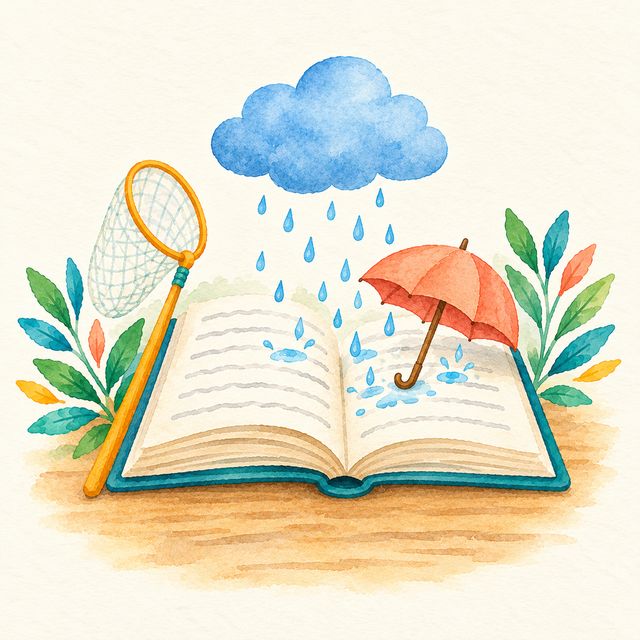
Your child tells a phrase meant word for word from one that is not, and says what it means.
Your child reads short scenes in which the Pet takes one phrase literally, taps that phrase in its sentence, then chooses what it really means, or at Grade 7–8 why the writer chose it.
- Grades 5–6 and 7–8
- 15 min
- Nothing to prepare
- On the screen
Free to sign up.
Is it a good fit?
- Ready if Your child reads a short paragraph on their own.
- Too much today? Start with Prove it: a passage read for what it says, before a phrase read for what it means.
- Too easy? The Grade 7–8 level: personification, irony and why the writer chose the words.
What your child practises
- Idioms
- Similes and metaphors
- Exaggeration
- Personification and irony (Grade 7–8)
- Why a writer picks a word (Grade 7–8)
“That can't really happen, so it means something else.”
If your child says something like this, in their own words, the idea has landed. Finishing the rounds means they took part; this is the learning.
Your part
- Nothing for the game itself
- Each question has a Read it to me button
Take it off the screen (optional)
Find a phrase in a book at home that isn't meant word for word, read it to someone, and say what it means.
More like this
The full design
What it is
Writers bend words on purpose. The Pet reads a short scene and takes one phrase word for word ("Cats and dogs falling from the sky! I'm fetching a big net."); your child finds that phrase in the scene and works out what it really means.
How it goes
The scene's phrases are underlined and each one is a button. A phrase that means just what it says is marked so, and the Pet says why; the one that is not meant word for word is marked, the scene names its kind (an idiom, a simile), the Pet shows how it pictured it, and three choices come. A choice that does not fit gets its own reason from the scene.
The Pet
It is the reader who takes everything literally, never your child: it fetches a net for the cats, a hammer for the ice. When the phrase is found it asks what the words do mean, and when the round is won it says it back plainly. Its dare is the next step up: at 5–6, one 7–8 scene, saying why the writer chose the words; at the top, a phrase like these found in a book at home and read to someone.
By band
Four scenes a play, two steps each: tap the phrase that is not meant word for word, then choose from three. 5–6 says what it means: an idiom (raining cats and dogs), a simile (as fast as a cheetah), a metaphor (our classroom was a zoo) and an exaggeration (a million times). 7–8 says why the writer chose it: personification (its dark windows watched us), irony ("Great. Just what I wanted," of a sandwich in the mud), a metaphor (Grandad's garden is a library) and an idiom (to break the ice).
What it grows
The language standards ask a Grade 5 child to interpret figurative language, including similes and metaphors, in context, and to recognise and explain common idioms (Common Core L.5.5a, L.5.5b); a Grade 6 child to interpret figures of speech such as personification (L.6.5a); a Grade 8 child to interpret verbal irony (L.8.5a); and from Grade 6 to say how a writer's choice of words shapes meaning and tone (RL.6.4 to 8.4). England's upper Key Stage 2 asks children to discuss how authors use figurative language and its effect on the reader. The game asks for the meaning and the reason, never a term to define.
Done, and what counts as evidence
Done means four phrases found and explained. "Asked could that really happen, word for word?" is an observation you may keep. The best record is off the screen: a phrase like these found in a book at home and read to someone.
What's personal
Nothing: every scene is written for the game, about no real person. No family facts are used. In Arabic the scenes are written in Arabic with Arabic's own phrases (the rain «كأفواه القِرَب», the noisy room a market), never translated word for word.