History · Grades 5–6 and 7–8
The Pet's dig
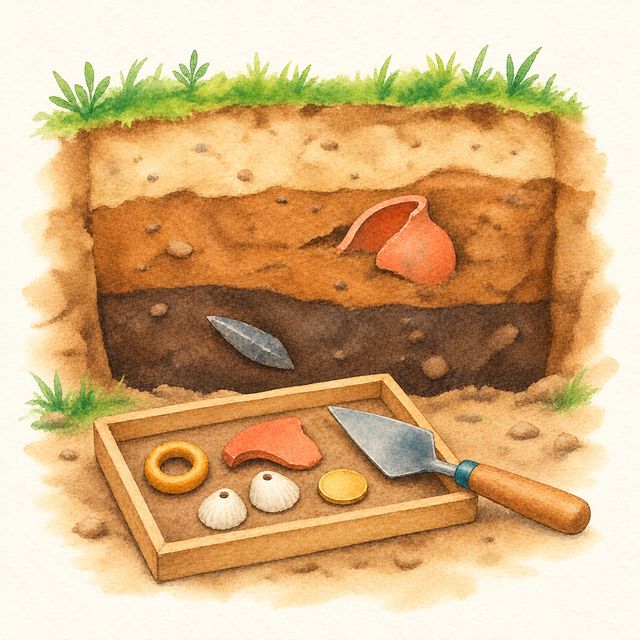
Your child works out how people lived long ago from what a dig finds, and says what the finds can't prove.
Your child puts right the Pet's dig: the oldest layer, a row of clay weights, three finds dated BCE and CE, and a pit of burnt grain, or at Grade 7–8 a coin too new for its layer, sea shells far from the sea, furniture never found, and the guess in a drawing of the house.
- Grades 5–6 and 7–8
- 15 min
- Nothing to prepare
- On the screen
Free to sign up.
Is it a good fit?
- Ready if Your child knows that years before year 1 are counted backwards.
- Too much today? Start with Older or newer?: putting real things in order of age, BCE and CE, before reading a dig.
- Too easy? The Grade 7–8 level: a later pit, trade, what rots, and the guess in a drawing.
What your child practises
- Deeper layers are older
- What a find shows about how people lived
- BCE and CE
- A later pit (Grade 7–8)
- What rots and what lasts (Grade 7–8)
“What did they find, and what else could explain it?”
If your child says something like this, in their own words, the idea has landed. Finishing the rounds means they took part; this is the learning.
Your part
- Nothing for the game itself
- Each question has a Read it to me button
Take it off the screen (optional)
Pick one thing at home together and say what a digger in a thousand years would guess from it, and what they would miss.
More like this
The full design
What it is
What a dig finds shows how people lived, and only what it shows. The Pet digs up a made-up village and draws the wrong conclusion the way children do ("The top layer is the oldest!"); your child puts it right from the evidence.
How it goes
The dig sits under the question: the side of the trench, a house floor seen from above, a pit, or a map. Then three answers, or three finds to tap with their words under them. A find or an answer that is not the one is marked "not this one", and the Pet says why.
The Pet
It believes the first thing it thinks, never your child: the top is oldest, rings are toys, a smaller number is older, everyone hunted, a coin dates its layer, shells mean the sea, missing means never there, and you cannot dig up a fire. When a round is won it says what the dig showed. Its dare is the next step up: at 5–6, the coin too new for its layer; at the top, one thing at home, and what a digger in a thousand years would guess from it and miss.
By band
Four rounds a play. 5–6: which of three layers is oldest (the Pet says the top), what a row of clay rings between two posts tells (the Pet says toys; they are a loom's weights), which of three finds dated 200 BCE, 400 BCE and 100 CE is oldest (the Pet says 200 BCE), and how the people got their food from a pit of burnt wheat by a grinding stone (the Pet says they hunted). 7–8: why a coin from 1900 lies in a layer of 500 BCE (the Pet trusts the coin; a later pit carried it down), why drilled sea shells lie 300 km from the sea (the Pet says the village was by the sea; trade), what a house with no furniture found says (the Pet says they had none; wood rots), and which part of a drawing of the house the dig cannot prove (the Pet says the fireplace; the roof).
What it grows
The C3 Framework asks a Grade 6 to 8 student to use evidence from different kinds of sources and to find the limits of the historical record (D2.His.9.6-8, D2.His.10.6-8), and the early grades of middle school study how early peoples lived from what archaeology finds. A dig reads its layers deepest first, and a later pit cut down through them is the first exception every digger learns to look for. The game asks for the reason, never a term to define.
Done, and what counts as evidence
Done means four finds explained. "Asked what they found, and what else could explain it" is an observation you may keep. The best record is off the screen: one thing at home your child explains as a digger would, with what it shows and what it can't.
What's personal
Nothing: the village is made up and drawn for the game, and no family facts are used. Every kind of find is one real digs turn up. Nothing is bought or priced. The Arabic lines are written in Arabic, every number as in English.