History · Kindergarten to Grade 1–2
Pumpkin Detective!
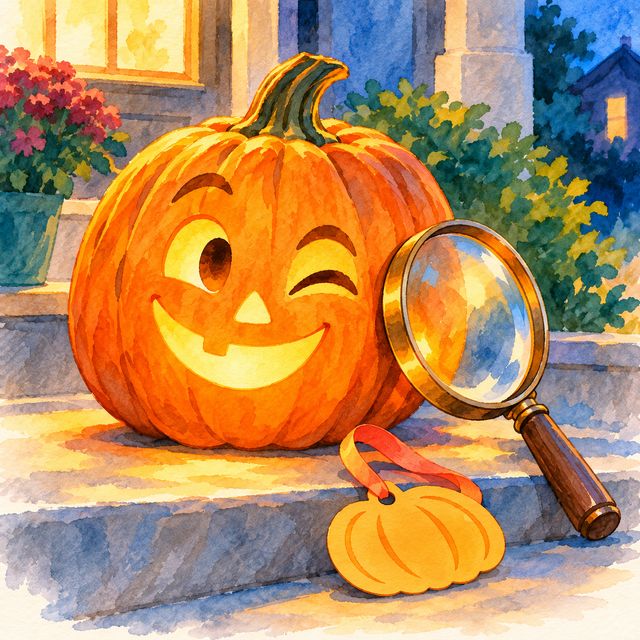
Your child notices what would go wrong on a walk after dark, and says why.
Your child fixes a costume that is not ready, chooses the safe way to a pumpkin on three painted streets, crosses in steps with the grown-up in the picture, and sends every treat to you to check.
- Kindergarten to Grade 1–2
- 8 min
- Nothing to prepare
- On the screen
Free to sign up.
Is it a good fit?
- Ready if Your child has walked somewhere after dark with you.
- Too much today? The K level: three things on the costume, one street, and the treat cards.
- Too easy? The Grade 1–2 level: the whole costume, three streets, and why a treat is set aside.
What your child practises
- A costume that is safe to walk in
- Where to cross, and when to wait
- Crossing in steps
- Every treat checked by a grown-up
“Wait, that car has white lights on.”
If your child says something like this, in their own words, the idea has landed. Finishing the rounds means they took part; this is the learning.
Your part
- Nothing for the game itself
- Each question has a Read it to me button
- Check the real costume or coat together before your next walk
Take it off the screen (optional)
Before your next walk after dark, check the costume or the coat together: can they see, can they walk, can drivers see them?
More like this
The full design
What it is
Getting ready for a walk after dark, on Halloween or any evening, by being the one who notices first. Your child finds what is not ready on a costume and fixes it, chooses the safe way to a winking pumpkin on three streets, crosses in steps with the grown-up, and sends every treat to you to check. It is the game of the storybook The Night the Pumpkins Winked, and plays well without it.
How it goes
Each part is one painting. On the costume, your child taps a thing that is not ready and picks the fix from two pictures; the right one plays a funny result (the dragon spins and does not trip). On a street, they tap where to go; a gap between parked vans is "not yet, could a driver see you there?", and the safe place glows. The crossing is four steps: stop at the curb, look every way and listen in either order, then across together. The treats are picture cards: every food goes to you to check, anything else is not food. At the table your child spots the four you set aside and picks why: torn open, no wrapper, a nut on it, no label. A tiny pumpkin hides in one of the paintings, somewhere new each day.
The Pet
It notices ("A tripping tail! Which one fixes it?"), asks which way is safe, and never chooses for your child. Its dare at 1–2 is away from the screen: one thing at home that shines in a flashlight, which the game never sees or keeps. At K it dares one more street.
By band
K: three things on the costume (a trailing tail or sheet, a hood or sheet over the eyes, slippers for outside), the street with the crosswalk and the crossing in steps, and the treat cards sorted. 1–2: all five on the costume (a dark back with nothing that shines, and no flashlight on the hook, too), three streets where the safe move differs (the crosswalk, waiting for a car backing out of a driveway, staying on our side because the pumpkin is on it), the sort, and the treat table: why you set a treat aside.
What it grows
Health Canada and Parachute advise a costume that fits and does not trip, a face painted rather than masked, something bright or reflective on it, a flashlight, a grown-up with young children, crossing at corners and crosswalks while still looking, and every treat checked by a grown-up before it is eaten, with any allergy in mind. The game practises each one as a thing to notice; it never says strangers are the danger.
Done, and what counts as evidence
Done means the costume, the streets and the treats. "Let me look first" is an observation you may keep. The best record is off the screen: your child pointing out, at the door, what would trip them or hide them in the dark.
What's personal
Nothing: the hall, the streets and the table are painted for the game, and no family facts are used. The grown-up in the pictures is any family's grown-up, never named.